Beginner course
Crystal Basics
Learn to describe a stone, compare it with other specimens and keep a record of what you find. Work through the photos and quizzes, then try three hands-on activities.
Your progress
0 of 9 lessons complete
Progress is saved in this browser. No sign-in needed.
Start lesson 1Lesson 1. Look before you name itDescribe colour, shine and shape.
Start with a description you could give to someone who hasn’t seen the stone. Note where the colour is darker, what catches the light and how the edge is shaped. Lustre is the way a surface reflects light. Check a second angle when a bright patch could be glare.
Look closely
Find the darkest purple area and a bright patch. Put each clue into a sentence starting with “I can see”.

Show our observation
The left side looks deeper purple. Several bright patches are on the right, and a pale area runs along the lower edge. Those are things you can record from this view. A second angle would help you tell which bright patches are reflections.
Lesson 2. Rock, mineral or crystal?Understand what each word describes.
A rock is a natural solid mass, often made of one or more minerals. A mineral is a naturally occurring material with characteristic composition and an ordered structure. Quartz is a mineral, and a single quartz crystal has that order throughout its structure. Obsidian is a volcanic rock made mostly of natural glass.
Look closely
Compare the two outlines. Which piece has a pointed end? Which has a rounded edge? Then consider whether those shapes tell you how the pieces are arranged inside.


Show our observation
Our Clear Quartz example tapers to a point on the left. Our Obsidian example is dark and rounded. Polishing can change an outer shape, and a glossy surface can occur on both minerals and glass. Use the collection labels to connect these examples to the material descriptions.
Lesson 3. Compare two similar stonesUse more than a shared colour.
A colour gives you a place to start. Compare where it appears, the shape of any existing faces and the pattern across the piece. A natural growth face or an existing break can help in a comparison. Take note when polishing or glare hides the clues.
Look closely
Write one similarity and one difference between the photos. Look at where purple appears and where pale areas interrupt it.

Show our observation
Both show purple. In the Amethyst photo, the deeper purple is toward the left. In the Rainbow Fluorite photo, much of the blue-purple is above irregular pale patches. Neither view gives a clear basis for identifying an unknown purple stone.
Lesson 4. See what changes in the lightTrack a flash as a stone turns.
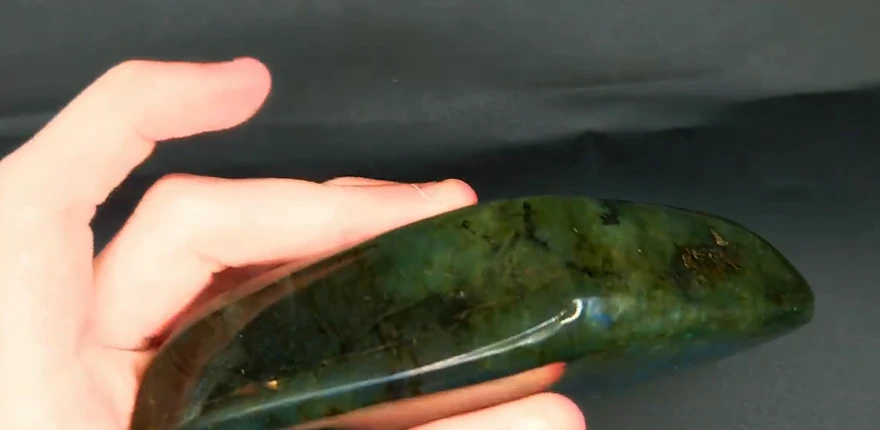
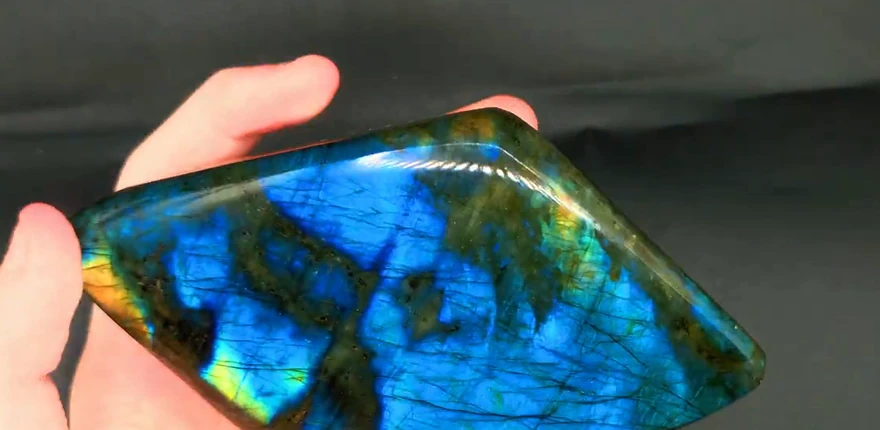
Watch the same area of a polished stone as the angle changes. A broad flash can appear or fade across the face. The colour flash associated with labradorite is called labradorescence. Light interacts with fine layers inside the material.
Look closely
Look at the same face in both stills. Describe where the blue appears and how much more of the surface it covers.
Show our observation
At 0:16 much of the face looks dark. At 0:18 blue covers a broader area as the stone turns. In a notebook, record the stone’s appearance at both angles so the bright view has context.
Lesson 5. Care for a specimenChoose a gentle first step.
Hardness measures scratch resistance. A hard stone can still chip, and attached material, dyes or repairs may need different care. Before cleaning, look for cracks and loose areas and check the care guidance for the whole piece. Keep an unfamiliar specimen dry while you check.
Look closely
Imagine this piece arrived without a label. Find an area where the colours meet and decide whether the photo tells you what cleaning method is safe.

Show our observation
The colour boundaries are easy to describe. A photo gives little information about the material’s sensitivity to water or about how it was finished. For this example, read the care notes in the specimen guide before attempting any cleaning.
Lesson 6. Keep a specimen recordSave observations, labels and open questions.
Keep the original label with the piece. Write your observations separately and add where you got the information. Photograph more than one side, add a ruler for scale and write down the dimensions you actually measure. Leave a field open when evidence is missing.
Look closely
Draft a record for this photo. Write the collection label, two visible details and one thing you would measure or photograph next.

Show our observation
The collection label is Rose Quartz. In this light the centre looks pale cream and softly mottled, and the outline is rounded. There is no ruler in the frame. For a fuller record, add a scale photo and write down the light used.
Lesson 7. See what light passes throughCompare a thin edge with a thicker part of the same piece.
Transmitted light passes through a specimen. Reflected light bounces off it. When light passes through clearly enough, you can see a mark behind the piece. A hazy area can let some light through and still hide the mark. Record what happens in each area you can observe.
Look closely
Compare a clearer-looking area in the Clear Quartz photograph with the bright rim in the Black Onyx photograph. Write one visible detail from each, then decide what you could check using a card and a steady lamp.

Try it yourself
What you’ll need A white card, a dark pencil or pen, a steady ordinary LED lamp and one small, sound specimen that can rest securely on a padded table.
- Draw a dark stripe on the card. Stand the card behind the supported piece and aim the lamp at the card from the side. Keep the lamp in place, away from the sample. Never hold the sample or card over the lamp.
- Look towards the stripe through a thin part of the specimen, then through a thicker part if one is visible from the same side. Keep the piece supported. For each area, record whether you can see the stripe, see some light with the stripe obscured, or see no light passing through in this setup.
- Note any bright reflection separately. Write down which parts you looked at and how you arranged the lamp. Leave the mineral identity open.
Using only photos Record one clearer-looking area and one bright surface highlight in the photos. Leave light transmission untested. Without a sample, draw where you would put the card, lamp and specimen.
Show our observation
The Clear Quartz photo shows clearer-looking and cloudier areas. The Black Onyx photo shows a dark patch, a warmer brown area and a bright right rim. A mark behind each piece under the same lighting would help compare how light passes through the two specimens.
Lesson 8. Measure a specimen with a rulerRecord the whole specimen’s dimensions in millimetres.
An unscaled photograph shows shape. Record dimensions from the piece itself. Use the longest direction as length, the widest distance across that direction as width and the distance from the base to the highest point as thickness. Note which side rested on the table so someone can repeat your measurements.
Look closely
Look at the Rose Quartz photo. Find the longest visible direction and sketch a line at a right angle for the width. Decide which side view would help you show the thickness.
Try it yourself
What you’ll need A millimetre ruler, a small sound specimen that rests steadily, a padded surface and paper to record the readings.
- Set the whole piece on the padded surface in a stable position. Choose the length and width directions before placing the ruler beside it. Line up the ruler’s zero mark with one end of the specimen.
- Look straight at the scale to read the length in millimetres. Measure the widest span at a right angle to the length. For thickness, stand the ruler beside the supported piece with zero level with its base and read the height from the side.
- Write length × width × thickness in mm, with a note about which side faced down. Use the precision your ruler supports. If you take a scale photo, show the whole outline and put the ruler beside the piece in the same plane as the dimension shown.
Using only photos Write “not measured” for the photographed stone. Draw an outline on paper and measure its length and width for practice. Label those readings as paper dimensions.
Show our observation
The photographed specimen has a rounded outline. The image provides no scale and does not show a suitable side view for thickness. Its dimensions stay unmeasured in this exercise.
Lesson 9. Trace a specimen’s originDistinguish a documented locality, a reported locality and an unknown one.
A locality record tells you where a particular specimen was collected. Ask what connects the place name to the piece, such as a collection number in a museum catalogue or a field note. Keep reported locations with their source, and leave the locality unknown when no location has been recorded.
Look closely
Describe a green band in our Malachite photo. Compare your note with the origin information for a separate piece, Australian Museum specimen D.5837, on the Mineral Atlas.

Try it yourself
What you’ll need Paper and pencil. The three examples below have enough information to complete the activity offline.
- Documented. The Australian Museum lists specimen D.5837, Albert Shaft, Peak Downs Copper Mine, Queensland, about 20 m deep. Write the museum name and number alongside the locality.
- Reported. In an imagined example, a seller says “Peak Downs” for another stone and supplies no collection record. Write “Peak Downs, reported by seller”. Keep a space for a document linked to that piece.
- Unknown. Our photograph shows green bands and carries the Malachite label, with no recorded place. Write “Locality unknown” and keep a separate note about the pattern.
Using only photos Draw three rows headed Documented, Reported and Unknown. Copy each locality and its source or evidence gap. A photograph can help you recognise which piece a record refers to, while a visible pattern alone leaves the locality open.
Show our observation
Our Malachite photo shows curved green bands, and its locality remains unknown. The museum record links its own specimen D.5837 to the Albert Shaft at Peak Downs Copper Mine in Queensland. That locality belongs to the museum record for that piece.